During a medical underwriting interview, the primary focus is usually on one thing:
What the applicant says.
But an interview contains more information than just the answers.
There are also signals in how the interaction happens — through audio, video, timing, and behaviour.
This is where AI can add another layer of intelligence to the underwriting process.
Looking Beyond the Answers
Imagine an applicant is completing a video-based medical underwriting interview.
They appear to be sitting alone in front of the camera.
Everything looks normal.
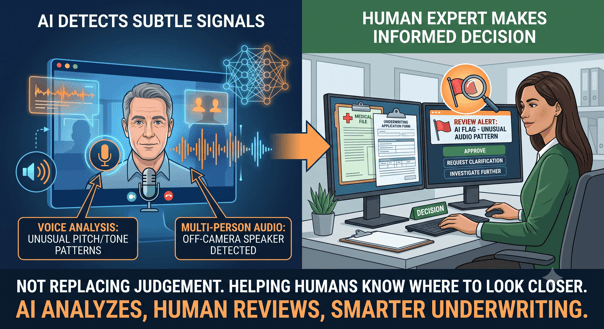
But during the conversation, the audio suggests that another person may be answering some of the questions from off-camera.
A human interviewer may not always notice this, particularly during a lengthy interview involving multiple questions and disclosures.
AI, however, can continuously analyze different signals throughout the interaction and identify patterns that may warrant further review.
What Could AI Look For?
Depending on the capabilities of the system, AI can analyze signals across:
- Audio — changes in voice characteristics or indications that more than one person may be speaking.
- Video — unexpected movement, additional people appearing in the frame, or other visual anomalies.
- Interaction patterns — unusual pauses, interruptions, or response patterns.
- Consistency — discrepancies between different signals collected during the interview.
These signals should not automatically be interpreted as evidence of fraud.
Instead, they can act as review triggers.
From Detection to Human Review
The important distinction is between identifying a signal and making a decision.
A responsible workflow could look like this:
AI identifies a potential anomaly
↓
The system flags it for review
↓
A human expert examines the relevant evidence
↓
The appropriate reviewer makes the final decision
This keeps human judgement at the centre of the underwriting process.
Why This Matters
Medical underwriting interviews can involve a large number of questions, applicants, and interactions.
Human reviewers cannot always observe every subtle signal in real time.
AI can provide an additional layer of continuous analysis — helping reviewers identify where they may need to look closer.
The value isn't necessarily in having AI make the decision.
The value can be in helping humans notice more, investigate efficiently, and make decisions with better contextual information.
The Future of AI-Assisted Underwriting
As underwriting becomes increasingly digital, the opportunity for AI goes beyond automating questionnaires and extracting information.
AI can potentially help analyze the interaction itself.
That creates a model where technology supports the human expert rather than replacing them:
AI detects the signal.
Human expert reviews it.
The appropriate reviewer makes the decision.
That's where AI can become another layer of intelligence in medical underwriting.
Not replacing human judgement.
Helping humans know where to look closer.