Why connecting health information matters in modern medical underwriting
Medical underwriting involves evaluating multiple aspects of an applicant's health before an insurance policy is assessed. From medical history and health declarations to diagnostic reports and additional observations, every piece of information can contribute to the overall assessment.
However, collecting this information is only one part of the process.
The real challenge lies in bringing different sources of medical information together, organizing them, and making them useful for underwriting teams.
As insurers continue to adopt digital technologies, there is an increasing opportunity to move beyond fragmented information collection towards more connected and intelligent underwriting workflows.
The Challenge: Medical Information Across Multiple Sources
A typical medical underwriting journey can involve several sources of information:
- Medical Questionnaires: Health-related information provided directly by applicants.
- Applicant Interviews: Responses collected through conversations and medical assessments.
- Medical Reports: Diagnostic reports, prescriptions, and other supporting documents.
- Video-Based Observations: Additional physiological insights derived through video analysis.
- Verification Details: Applicant identity and other relevant verification information.
While each source provides valuable information, managing them across separate stages can make the underwriting process more complex.
Underwriting teams need a consolidated view to review the information efficiently and understand the applicant's overall medical profile.
Moving Towards Connected Medical Underwriting
At Wizergos, we're addressing this challenge through Zeriskify, our AI-powered medical underwriting solution.
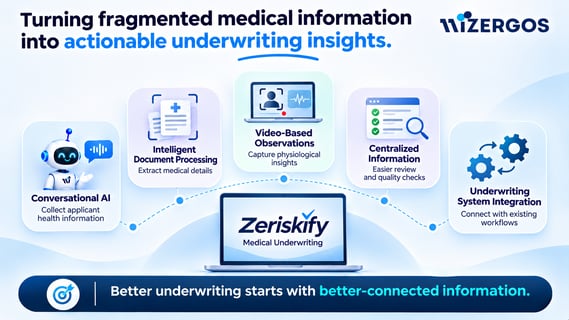
Rather than treating each stage as an isolated activity, Zeriskify brings multiple capabilities together to support a more connected information journey.
1. Conversational AI for Medical Information Collection
Instead of relying entirely on traditional questionnaires, conversational AI enables applicants to share their medical history through interactive interviews.
The system can guide applicants through relevant health-related questions and collect structured responses.
2. Intelligent Medical Document Processing
Medical reports and supporting documents often contain valuable information that needs to be reviewed and extracted.
AI-powered document processing helps identify and organize relevant medical details, reducing the need for repetitive manual data entry.
3. Video-Based Health Observations
Video-based assessment introduces another dimension to digital medical underwriting.
Using Remote Photoplethysmography (rPPG), the solution aims to estimate physiological parameters such as heart rate, blood pressure, oxygen saturation (SpO₂), and stress index through facial video analysis.
These observations can complement other applicant-provided medical information, subject to appropriate validation.
4. Centralized Information for Review and Quality Checks
Once the interview and information collection stages are completed, applicant responses, medical details, and relevant observations can be consolidated for review.
This gives quality-check teams and underwriters a more organized view of the information collected throughout the journey.
5. Integration with Existing Underwriting Systems
The value of collecting and organizing information increases when it can be made available within the insurer's existing ecosystem.
Zeriskify is designed to integrate with existing Underwriting Workbenches and rule-based engines, helping insurers connect AI-powered information collection with their established underwriting processes.
From Fragmented Data to Actionable Insights
Connecting different sources of medical information creates an opportunity to improve how underwriting teams access and review applicant details.
A more connected approach can help insurers:
- Reduce repetitive manual information handling.
- Improve accessibility of applicant medical information.
- Bring multiple sources of information into a consolidated workflow.
- Support more efficient review and quality-check processes.
- Integrate AI-powered capabilities into existing insurance infrastructure.
Importantly, technology-generated observations and extracted information should be validated and reviewed appropriately. They complement professional underwriting assessments rather than independently replacing clinical judgment or underwriting decisions.
What's Next for Medical Underwriting?
The next phase of digital medical underwriting will not be defined by a single AI capability.
It will be shaped by how effectively different technologies work together.
Conversational AI, intelligent document processing, computer vision, and enterprise integrations can collectively help create a more connected underwriting ecosystem.
At Wizergos, we're working towards this vision through Zeriskify, bringing together different stages of medical information collection and assessment.
The opportunity is bigger than collecting more data. It's about connecting the right information and making it meaningful for underwriting.