
Medical underwriting is one of the most important stages in the insurance journey. It enables insurers to evaluate an applicant's health profile, understand potential risks, and determine appropriate coverage.
However, traditional underwriting processes often involve extensive documentation, lengthy medical interviews, manual data extraction, and multiple verification steps.
As insurance applications become increasingly digital, insurers need more efficient ways to collect, process, and evaluate medical information.
This is where Artificial Intelligence (AI) is creating new possibilities.
Why Does Medical Underwriting Need Modernization?
Traditional medical underwriting presents several operational challenges:
1. Time-consuming applicant interviews
Collecting detailed medical histories requires applicants to answer multiple questions. Additional follow-ups and clarifications can make the process even longer.
2. Manual medical report analysis
Underwriting teams often need to review prescriptions, laboratory reports, diagnostic records, and other medical documents to understand an applicant's health profile.
3. Inconsistent information collection
Different interview approaches and incomplete responses can result in missing or inconsistent medical information.
4. Language and accessibility barriers
Applicants may find it difficult to understand medical terminology or communicate their health information in a language they are comfortable with.
5. Delayed underwriting decisions
When information is scattered across documents, interviews, and multiple systems, underwriting teams spend additional time consolidating and validating data.
5 Ways AI Can Improve Medical Underwriting
1. Intelligent Medical Interviews
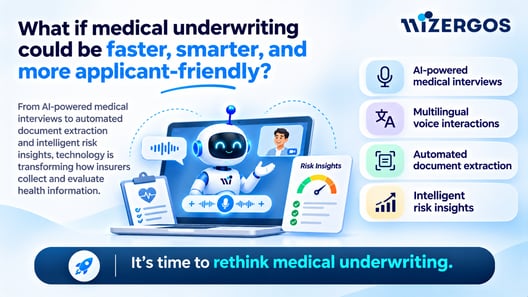
AI-powered conversational systems can conduct structured medical interviews, ask relevant questions, and generate contextual follow-ups based on applicant responses.
This helps insurers collect more organized medical information while reducing repetitive manual interactions.
2. Multilingual Voice-Based Interviews
Voice-enabled AI can make medical interviews more accessible by allowing applicants to communicate in supported regional languages.
Applicants can respond naturally instead of navigating lengthy forms, creating a more convenient interview experience.
3. Automated Medical Document Extraction
AI-powered OCR and document intelligence can extract relevant information from medical reports, prescriptions, and laboratory results.
The extracted information can be organized into structured fields, making it easier for underwriting teams to review medical records.
4. Identity Verification and Applicant Validation
Integrating identity verification, Aadhaar checks, and live photo matching into the interview journey can help insurers establish applicant identity and strengthen verification workflows.
5. AI-Assisted Underwriting Insights
AI can consolidate applicant responses and extracted medical information into structured summaries.
These insights can help underwriters review relevant information more efficiently while retaining human oversight over final risk assessment and underwriting decisions.
Building a Connected Medical Underwriting Journey
The real opportunity is not simply introducing individual AI tools into existing workflows. It is connecting the entire medical underwriting journey.
An intelligent underwriting workflow can bring together:
- Applicant registration and identity verification.
- AI-powered medical interviews.
- Contextual follow-up questions.
- Medical document uploads and extraction.
- Quality checks and information validation.
- Structured medical summaries for underwriter review.
When these capabilities work together, insurers can reduce fragmented processes and create a more connected experience for both applicants and underwriting teams.
How Wizergos Is Bringing AI into Medical Underwriting
At Wizergos, we are helping insurance organizations modernize medical underwriting through AI-powered automation and configurable workflows.
Our Medical Underwriting solution combines conversational AI, multilingual voice interactions, identity verification, automated document processing, and structured medical information collection.
The platform is designed to help insurers:
- Conduct interactive medical interviews.
- Support applicants through multiple Indian languages.
- Capture and organize medical information.
- Extract relevant details from uploaded medical documents.
- Integrate identity verification into the interview process.
- Provide structured information for quality checks and underwriter review.
By bringing these capabilities into a unified workflow, Wizergos aims to simplify medical information collection and improve operational efficiency.
Conclusion: Moving Towards Intelligent Medical Underwriting
The future of medical underwriting lies in combining human expertise with intelligent automation.
AI can help insurers move beyond manual interviews and fragmented document processing towards connected, efficient, and applicant-friendly workflows.
As the insurance industry continues to evolve, adopting AI-driven underwriting solutions can help organizations build more scalable operations while keeping accuracy, compliance, and human oversight at the center.
Ready to explore smarter medical underwriting?
Discover how Wizergos is bringing AI and automation into insurance workflows.