
When we talk about AI in insurance, the conversation often focuses on what the AI can do.
Can it understand language?
Can it ask questions?
Can it identify relevant information?
Can it generate a report?
But in medical underwriting, there may be another benefit that is just as important:
How the information is captured.
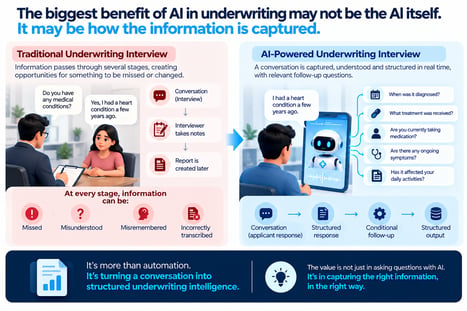
The hidden problem in traditional interviews
Consider a traditional medical underwriting interview.
An applicant answers a question.
The interviewer listens.
The interviewer takes notes.
Later, those notes may be converted into a report.
It looks simple.
But information is passing through multiple stages:
Applicant → Interviewer → Notes → Report → Underwriting Record
And every handoff creates an opportunity for information to be:
Missed → misunderstood → misremembered → incorrectly transcribed
A small gap at the beginning can become a meaningful gap in the final underwriting record.
What changes with an automated interview?
An automated interview can reduce some of these manual handoffs by capturing the conversation directly and applying predefined logic to the applicant's responses.
Instead of:
Conversation → Notes → Report
the process can move toward:
Conversation → Structured response → Conditional follow-up → Structured output
The difference is important.
The system isn't simply replacing someone who takes notes.
It is changing the way information moves through the underwriting process.
From answers to relevant follow-ups
Medical underwriting isn't just about collecting answers.
Sometimes, an answer should trigger another question.
For example:
Applicant:
“I had a heart condition several years ago.”
Instead of simply recording:
Heart condition: Yes
an automated interview can be designed to follow the relevant underwriting logic:
When was it diagnosed?
↓
What treatment was received?
↓
Are you currently taking medication?
↓
Are there any ongoing symptoms?
The result is not just a longer conversation.
It is a more structured collection of information around a potentially important underwriting factor.
Turning conversations into structured data
This is where AI-assisted underwriting becomes particularly interesting.
A conversation contains rich information, but conversations are not naturally structured for downstream underwriting systems.
Automation can help transform that conversation into structured outputs.
For example:
| Conversation | Structured Output |
|---|---|
| “I had asthma as a child.” | Medical history: Asthma |
| “I haven't taken medication for years.” | Current medication: No |
| “My last episode was around 2018.” | Last episode: 2018 |
| “I have no current symptoms.” | Current symptoms: No |
The goal is not simply to generate a transcript.
The goal is to make the information usable.
From conversation to underwriting intelligence
This is ultimately more than automation.
It is a shift in how insurers think about the information collected during underwriting.
A conversation is not just something that happens before an underwriting decision.
It is the source of the underwriting data.
And the better that source is captured, structured and preserved, the more useful it can become across the insurance lifecycle.
The future of AI in underwriting may therefore not be about replacing the conversation.
It may be about turning the conversation into structured underwriting intelligence.
.png)