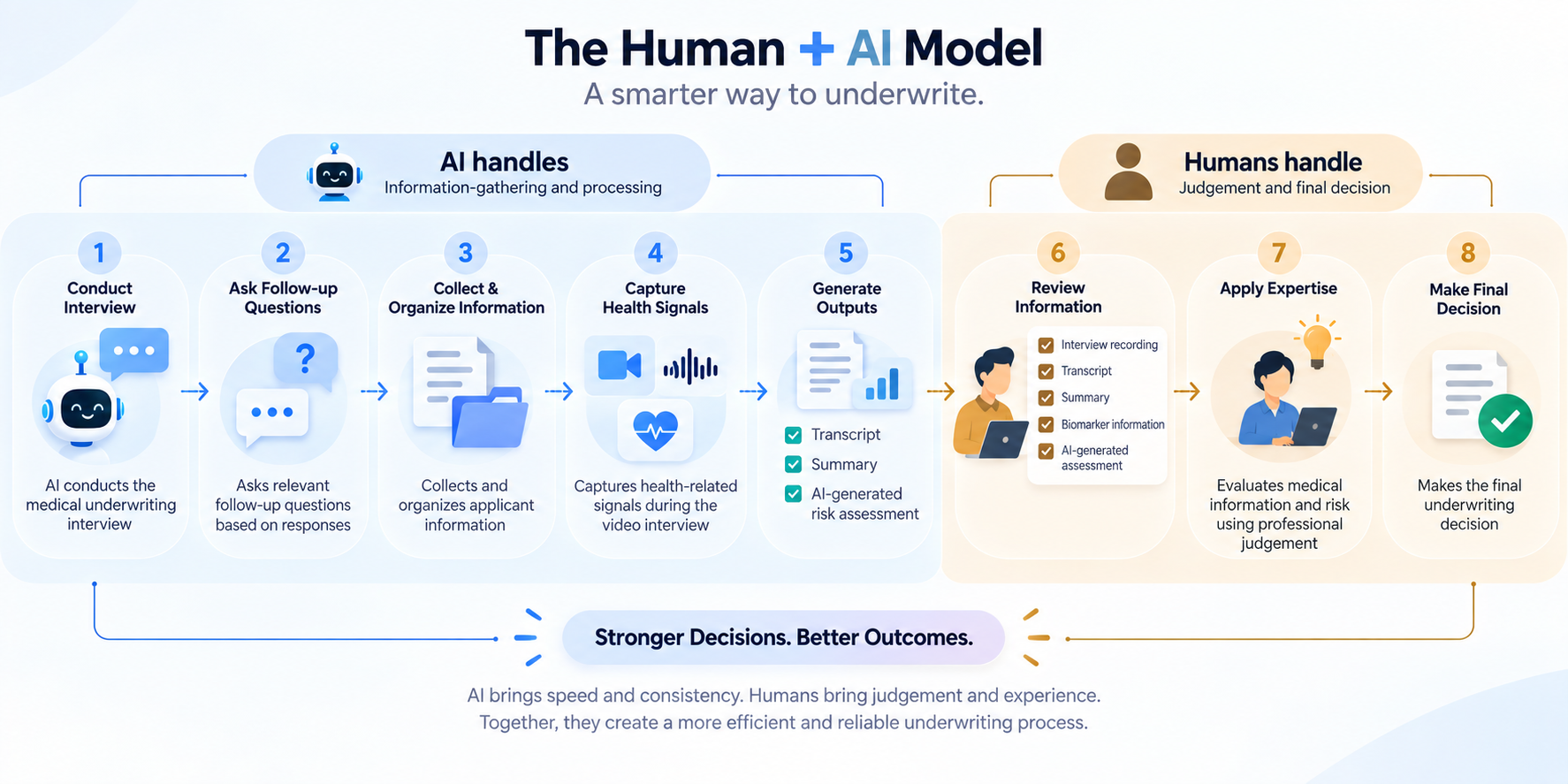
Video has traditionally played a simple role in insurance: allowing the applicant and interviewer to see and communicate with each other during a medical underwriting interview.
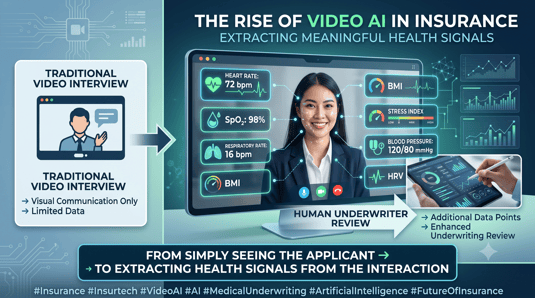
But with the development of Video AI, that role could become much broader.
During a video-based medical underwriting interview, AI can potentially capture and analyze health-related signals from the interaction. Depending on the technology and validation available, these may include indicators such as heart rate, SpO₂, respiratory rate, BMI, HRV, stress index and blood pressure.
Instead of video being used only for communication, it can become another source of structured information that supports the underwriting process.
This can be particularly useful in a human-in-the-loop underwriting model. The AI system can conduct the interview, capture relevant information and health-related signals, and present these alongside the applicant’s responses. The health or life underwriter can then review the available information and apply professional judgement during the underwriting assessment.
The potential value is not about replacing existing medical assessments or treating AI-generated signals as a final decision. Rather, it is about providing underwriters with additional data points that may help them understand the applicant more comprehensively.
Video AI can also complement conversational underwriting. While the AI asks relevant questions and follows predefined underwriting goals, the video interaction can potentially provide additional signals alongside the applicant’s verbal responses.
This changes the role of video in insurance:
From simply seeing the applicant → to extracting meaningful, technology-enabled insights from the interaction.
As computer vision, remote sensing and AI technologies continue to evolve and become more rigorously validated, video could become an increasingly important component of digital health and life insurance underwriting.
The future of underwriting may not be about collecting information through a single channel.
It may be about combining conversation, video and AI to give underwriters a more comprehensive view of risk.