
Artificial intelligence is changing how insurance companies collect, process and evaluate medical information.
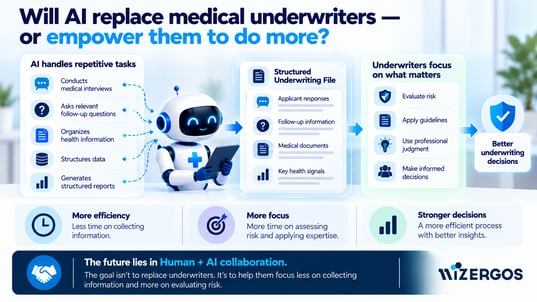
From conducting applicant interviews to asking relevant follow-up questions and generating structured reports, AI can automate several time-consuming parts of medical underwriting.
But an important question remains:
Will AI replace medical underwriters, or will it help them do their jobs better?
The answer may lie in how effectively humans and AI work together.
Medical underwriting is more than data collection
Before an underwriter can assess an applicant's risk, information needs to be gathered, organized and reviewed.
Traditionally, this process can involve manual interviews, documentation, medical history reviews and report preparation.
These activities are essential, but they can also consume valuable time.
More importantly, collecting information is only one part of underwriting.
An underwriter must interpret the applicant's medical history, understand relevant context, apply underwriting guidelines and exercise professional judgment before reaching a decision.
AI can help organize the information. Evaluating what that information means still requires careful assessment and appropriate oversight.
Where AI can make a difference
AI-assisted medical underwriting can support several stages of the process.
1. Automated medical interviews
AI can guide applicants through structured medical interviews, helping collect relevant health information consistently.
2. Dynamic follow-up questions
When an applicant discloses a medical condition, AI can trigger relevant follow-up questions based on predefined underwriting goals and configured logic.
3. Structured information capture
Applicant responses can be converted into organized data, reducing dependence on manual note-taking and transcription.
4. Summarization and report generation
AI can help prepare structured summaries of the applicant's medical history, making information easier for underwriters to review.
5. Highlighting information for review
AI can flag missing information, inconsistencies or potential risk indicators for further assessment, subject to the system's capabilities and validation.
Together, these capabilities can help reduce repetitive information-gathering and preparation work.
What remains important about human expertise?
Medical underwriting involves decisions that require context and judgment.
Two applicants may disclose similar medical conditions but have different medical histories, treatment experiences or other relevant circumstances.
An underwriter needs to evaluate the available evidence against the insurer's guidelines and determine what additional assessment may be necessary.
Human expertise remains important for:
- Interpreting complex medical histories.
- Evaluating the relevance of disclosed information.
- Applying underwriting guidelines appropriately.
- Resolving ambiguity and reviewing exceptions.
- Making or approving decisions within the insurer's governance framework.
AI-generated summaries and risk indicators should support these responsibilities, not replace independent review where it is needed.
The future: Human + AI collaboration
Rather than viewing AI and underwriters as competing alternatives, insurers can design a workflow in which each contributes where it is most useful.
Consider two complementary roles.
AI focuses on information processing:
Interview → Follow-ups → Transcription → Structuring → Summarization
The underwriter focuses on risk assessment:
Interpretation → Context → Guidelines → Judgment → Decision
This division can help underwriters spend less time preparing information and more time evaluating cases.
The precise benefits will depend on the quality of the AI system, the complexity of the underwriting workflow and how effectively the technology integrates with existing processes.
Measure success by better underwriting work
The success of AI in medical underwriting shouldn't be measured only by the number of tasks automated or the speed of report generation.
Insurers should also examine whether AI helps reduce manual effort, improve information completeness, identify gaps earlier and give underwriters more time to focus on complex cases.
Accuracy, consistency, explainability and appropriate human oversight must remain central to the process.
The objective is not automation for its own sake. It is a more effective underwriting workflow.
AI doesn't have to replace expertise to transform underwriting
The future of medical underwriting does not have to be a choice between artificial intelligence and human judgment.
AI can help collect and organize information, while underwriters apply their expertise to interpret that information and assess risk.
The goal isn't to replace underwriters. It's to help them focus less on collecting information and more on evaluating risk.
Because the greatest opportunity may not be AI making every decision.
It may be AI giving human experts better information, better tools and more time to make informed decisions.