
Medical underwriting is not simply about asking a set of health questions.
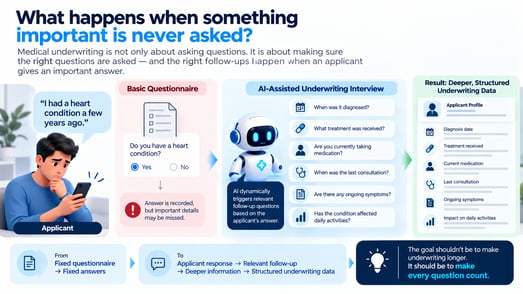
It is about understanding the applicant well enough to identify the information that actually matters for risk assessment.
And sometimes, the most important information is hidden inside a single answer.
Consider a simple example
An applicant says:
“I had a heart condition a few years ago.”
A traditional questionnaire may capture this as a simple Yes/No response or record the statement as part of the applicant's medical history.
But is that enough?
Probably not.
A meaningful underwriting conversation may need to explore:
- When was the condition diagnosed?
- What treatment was received?
- Is the applicant currently taking any medication?
- When was their last consultation?
- Are there any ongoing symptoms?
- Has the condition affected their daily activities?
- Has there been any recurrence or follow-up treatment?
The value isn't necessarily in asking more questions.
The value is in asking the right next question.
From questionnaires to conversations
Traditional underwriting processes often follow a predefined sequence.
Question → Answer → Next Question
This works well when every applicant follows roughly the same path.
But medical histories are rarely that predictable.
One answer can completely change what should be asked next.
For example:
Applicant:
“I had a heart condition a few years ago.”
AI:
“When was it diagnosed?”
Applicant:
“About four years ago.”
AI:
“Did you undergo any treatment or surgery for it?”
Applicant:
“Yes, I was prescribed medication.”
AI:
“Are you currently taking any medication for the condition?”
The conversation becomes responsive to the applicant rather than simply following a fixed questionnaire.
Where AI-assisted underwriting becomes interesting
AI can be designed to follow predefined underwriting goals while dynamically triggering relevant follow-up questions based on the applicant's responses.
The objective isn't to let AI ask random questions.
It is to combine structured underwriting logic with the flexibility of a conversational interface.
A simplified flow could look like:
Applicant Response
↓
Identify Relevant Information
↓
Trigger Appropriate Follow-up
↓
Capture Additional Context
↓
Convert Responses into Structured Underwriting Data
This can help underwriting teams collect more meaningful information without requiring every applicant to answer the same long list of questions.
The real challenge: knowing when to go deeper
Not every answer requires a follow-up.
If an applicant says:
“I had a fever last year and recovered completely.”
The conversation may not need several additional questions.
But if the applicant says:
“I was diagnosed with a heart condition and I'm still taking medication.”
That answer may warrant deeper exploration.
This is where intelligent follow-up logic becomes important.
The system needs to understand not just what was said, but also when the answer should trigger another question.
Better underwriting doesn't necessarily mean longer underwriting
One common misconception is that collecting more information automatically means asking more questions.
That's not necessarily true.
A poorly designed process can ask dozens of questions that add little value.
A well-designed conversational process can ask fewer questions but make each one more relevant.
The goal is not:
More questions.
The goal is:
More meaningful information from the right questions.
From fixed questionnaires to adaptive conversations
The evolution can be thought of simply:
Fixed questionnaire → Fixed answers
to
Applicant response → Relevant follow-up → Deeper information → Structured underwriting data
This shift can make the underwriting experience more conversational while still maintaining the structure required for risk assessment.
For insurers, the opportunity is not simply to automate a questionnaire.
It is to build an underwriting conversation that knows when an answer deserves another question.
Because sometimes, the most important underwriting insight is hidden in what happens after the first answer.
The goal shouldn't be to make underwriting longer.
It should be to make every question count.