
Insurance fraud is becoming more sophisticated. As digital insurance journeys evolve, fraud detection needs to look beyond traditional document and information checks.
Traditionally, insurers have relied heavily on the information provided by applicants and the documents submitted during the application process. These checks remain important, but a digital underwriting journey can provide additional signals that may help identify cases requiring closer examination.
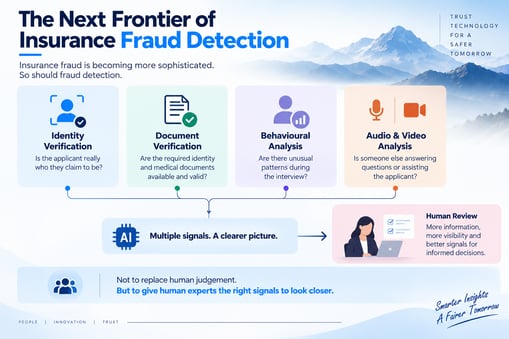
What if fraud detection could look beyond documents?
AI can bring together multiple layers of verification during the insurance journey.
1. Identity Verification
The first question is simple:
Is the applicant really who they claim to be?
AI-powered identity verification can combine techniques such as facial matching, liveness detection and identity validation to provide additional confidence around an applicant's identity.
2. Document Verification
Documents can provide valuable information, but they can also contain inconsistencies or require additional validation.
AI can assist with:
- Document verification
- Data extraction
- Authenticity checks
- Tamper detection
- Expiry validation
This can help insurers review identity and medical documents more efficiently.
3. Behavioural Analysis
A digital underwriting interview creates another source of information: the interaction itself.
AI can analyze patterns during the interview and identify signals that may require further review, such as unusual response patterns, inconsistencies or unexpected interaction behaviour.
These signals should not automatically be interpreted as fraud. Instead, they can provide additional context for a human reviewer.
4. Audio & Video Analysis
Video interviews can provide information beyond what is visible on screen.
For example, an applicant may appear to be alone in front of the camera while the audio suggests that another person is answering questions from off-camera.
AI can analyze audio and video signals and flag such anomalies for further examination.
Bringing the signals together
The real opportunity isn't any single verification method.
It is the ability to combine multiple signals.
Identity + Documents + Behaviour + Audio/Video
Together, these layers can give insurers a broader view of the application and help surface cases that may need closer examination.
AI doesn't have to make the final decision
One of the most important principles in this approach is keeping humans in the loop.
The workflow can be:
AI identifies a signal → Human expert reviews the context → Appropriate reviewer makes the final decision
The purpose isn't to have AI automatically label an applicant as fraudulent.
It's about giving insurers more information, greater visibility and stronger signals to support human review.
The future of fraud detection
As insurance becomes increasingly digital, fraud detection can evolve from checking isolated pieces of information to understanding the broader interaction.
AI can help connect signals across identity, documents, behaviour, audio and video.
The goal isn't simply more automation.
It's better information for better-informed human decisions.
AI doesn't replace human judgment. It helps humans know where to look closer.