
For years, medical underwriting has largely followed a straightforward process:
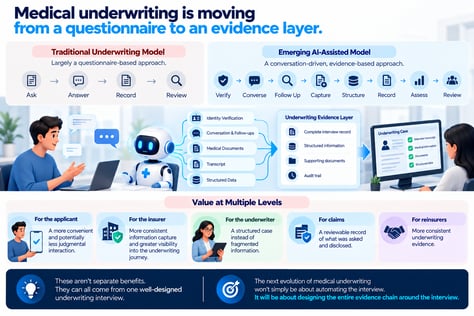
Ask → Answer → Record → Review
The applicant answers questions about their medical history. The information is documented, reviewed by an underwriter, and used to support a risk assessment.
But what if the future of medical underwriting is not just about collecting answers?
What if it is about creating a reliable, structured and reviewable record of the entire underwriting journey?
This is where AI-assisted medical underwriting becomes interesting.
From questionnaires to evidence-driven interviews
A traditional questionnaire follows a predefined sequence. While this works for collecting standard information, medical histories can be complex. One answer may require several follow-up questions to understand the context.
An AI-assisted interview can introduce a more adaptive process:
Verify → Converse → Follow Up → Capture → Structure → Record → Assess → Review
Each stage serves a purpose, from establishing the applicant's identity to capturing responses, asking relevant follow-up questions and organizing the information for review.
The result is an opportunity to move beyond simply digitizing a questionnaire and toward designing a more complete evidence chain.
The value extends beyond the interview
A well-designed underwriting interview can create value for multiple stakeholders across the insurance lifecycle.
1. For the applicant: A more comfortable experience
Discussing medical history can be sensitive. A conversational interface may provide a more convenient and potentially less judgmental environment for sharing personal health information.
Clear questions, relevant follow-ups and consistent interactions can help make the process easier to navigate.
2. For the insurer: More consistent information capture
When interviews depend heavily on manual processes, the quality of information capture can vary.
AI-assisted interviews can apply predefined questioning logic consistently, capture responses and trigger relevant follow-ups based on applicant answers.
This can help reduce information gaps, although the quality of the outcome still depends on system design, validation and oversight.
3. For the underwriter: A structured case
Underwriters need more than a collection of disconnected answers.
They need organized information that helps them understand the applicant's disclosures and identify details that require further review.
Structured outputs can make the information easier to navigate and help underwriters focus on assessment rather than reconstructing the interview from fragmented notes.
4. For claims: A reviewable record
The underwriting decision may be made today, but a question about what was disclosed could arise years later.
A reviewable record of the questions asked, the applicant's responses and the follow-ups conducted can help the insurer understand what happened during the original interview.
Such a record does not automatically prevent disputes or establish that every disclosure was accurate. It provides evidence that can support subsequent review.
5. For reinsurers: Greater visibility into underwriting practices
Reinsurers need visibility into the quality and consistency of the risks being transferred to them.
Structured, consistently captured underwriting information and an auditable trail can support the review of underwriting practices and the evidence available for individual cases.
The value depends on the completeness, reliability and relevance of the information provided.
One interview. Multiple layers of value.
These benefits are connected.
A well-designed interview can support the applicant experience, improve the consistency of data capture, provide underwriters with structured information and preserve a record for future review.
Consider the complete chain:
Applicant interaction → Medical disclosure → Relevant follow-up → Captured response → Structured data → Underwriting review → Auditable record
If each stage is designed properly, the interview becomes more than a step in the policy issuance process.
It becomes a source of structured information that can support multiple stages of the insurance lifecycle.
The real opportunity is in the evidence chain
It is easy to define AI in underwriting by its most visible features: conversational interfaces, automated questioning or report generation.
But these capabilities are only part of the picture.
The larger opportunity is to connect them into a process where information is captured consistently, structured meaningfully and preserved for review.
That requires more than a capable AI model. It requires well-defined underwriting goals, appropriate follow-up logic, reliable data capture, validation, traceability and human oversight where needed.
Automating the interview is one step. Designing the evidence chain around it is the bigger opportunity.
Medical underwriting may be moving from a process focused primarily on asking questions to one that also focuses on how information becomes reliable, reviewable underwriting evidence.
The future may not simply be about making underwriting faster.
It may be about making the entire journey more consistent, transparent and traceable.