
ake subsequent reviews more challenging. For the reinsurer, it can make it harder to understand the evidence supporting an individual underwriting case, depending on what documentation is available.
The issue isn't simply whether a file exists.
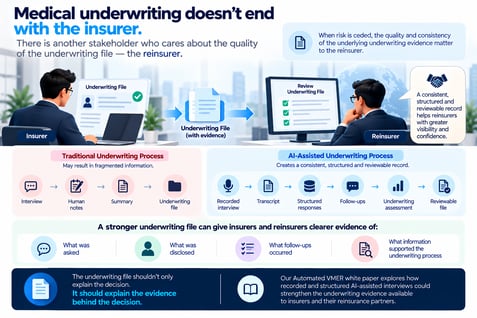
It's whether the file clearly explains how the information was collected and what evidence supports it.
From documentation to traceability
Now consider an AI-assisted medical underwriting workflow:
Recorded interview → Transcript → Structured responses → Follow-ups → Underwriting assessment → Reviewable file
Each stage contributes to a more traceable record.
- Recorded interview: Preserves the original interaction, subject to appropriate consent, privacy and retention requirements.
- Transcript: Creates a text-based record of the conversation.
- Structured responses: Organizes medical information into defined fields.
- Follow-ups: Captures additional information requested in response to relevant answers.
- Underwriting assessment: Connects the collected information to the assessment process.
- Reviewable file: Brings the available evidence together for subsequent examination.
The objective is to make it easier to understand what happened during the underwriting process without relying entirely on manually prepared summaries.
Why this matters to reinsurers
Reinsurers need to evaluate the risks they accept and understand the underwriting practices behind the business they support.
A consistent, structured and reviewable underwriting record can help provide visibility into several questions:
What was asked?
The record can show which questions formed part of the interview.
What was disclosed?
Applicant responses can be preserved in transcripts and structured fields.
What follow-ups occurred?
The record can help establish whether additional questions were asked in response to relevant disclosures.
What information supported the assessment?
The documentation can help reviewers connect the applicant's disclosures with the information considered during underwriting.
The usefulness of this evidence depends on its accuracy, completeness, accessibility and the controls governing its capture and retention. A recorded interview alone does not guarantee that every disclosure is accurate or that every relevant question was asked.
Nevertheless, designing for traceability from the beginning can make the underwriting file more useful beyond the original policy issuance.
The value extends beyond the original decision
An underwriting file may need to be revisited long after a policy is issued.
A claims investigation, an internal audit or a reinsurance review may require a closer examination of the original medical disclosures and the information available when the risk was assessed.
If the file contains only a high-level summary, reconstructing the original conversation may be difficult.
A well-designed evidence trail can help reviewers distinguish between the original response, subsequent follow-up information, structured data and the conclusions reached during assessment.
This does not eliminate disagreements or guarantee that a claim will be resolved in a particular way. It provides a clearer basis for reviewing the underwriting process.
AI is not just about automating the interview
It is easy to evaluate AI-assisted underwriting by asking how quickly an interview can be completed or how much manual effort can be removed.
Those measures matter, but they tell only part of the story.
The broader opportunity is to design a process in which the information collected during the interview remains traceable throughout the underwriting workflow.
That requires more than conversational AI. It requires structured data capture, appropriate follow-up logic, reliable records, access controls, auditability and clear links between the collected evidence and the assessment.
For insurers, this can support more consistent underwriting documentation.
For underwriters, it can make case information easier to review.
For reinsurers, it can provide a clearer view of the evidence available behind the underwriting process.
The underwriting file should tell the complete story
Medical underwriting does not necessarily end when the insurer makes a decision.
The information behind that decision may continue to matter throughout the policy lifecycle and across the broader insurance ecosystem.
That is why the goal should be bigger than automating a medical interview.
It should be to create a structured, traceable and reviewable evidence chain that preserves the connection between what was asked, what was disclosed and what supported the assessment.
The underwriting file shouldn't only explain the decision. It should explain the evidence behind the decision.