
A customer doesn’t see your company as a collection of departments. To them, you are a single entity. They don’t care if they are talking to Marketing, Sales, or Customer Support; they expect a consistent, contextual, and seamless experience. Yet, internally, many organizations operate in functional silos, causing a fragmented and often frustrating customer journey.
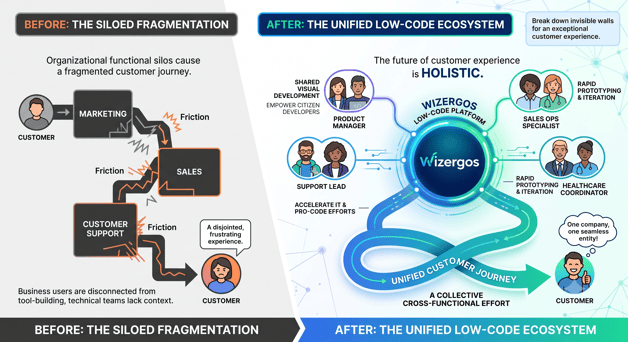
Industry analysis of mature CX organizations reveals a common thread: they prioritize a cross-functional structure. They understand that delivering a truly exceptional customer experience is not the sole responsibility of one department but a collective effort. The challenge, however, has always been technological. How do you give diverse teams like Sales, Support, and IT a common platform to build and manage these unified customer journeys?
This is the problem that Low-Code Application Platforms are solving with remarkable efficiency.
The Collaboration Gap in Traditional Development
Traditionally, creating a cross-functional workflow was a complex and sluggish process. A business analyst in the support team would identify a process inefficiency. They would write a detailed requirements document and hand it over to the IT department. The IT team, juggling a long backlog, would eventually build a solution. By the time it was deployed months later, the initial business need might have already evolved.
This model creates a natural friction between teams. Business users who understand the customer's needs best are disconnected from the tool-building process, and the technical teams lack the deep, real-time business context. The result is a disjointed customer experience where the handoff between marketing automation, the CRM, and the support desk feels jarring.
Low-Code as the Unifying Language
A low-code platform like Wizergos acts as a bridge, creating a shared space where different teams can speak the same language. It democratizes development, empowering non-technical users while providing the robust, enterprise-grade tools that professional developers require.
Here’s how it transforms cross-functional collaboration for CX:
- Shared Visual Development: With a drag-and-drop interface and visual workflow builders, a product manager, a support lead, and a developer can all sit in the same virtual room and map out a customer journey. This shared understanding from the outset is invaluable and drastically reduces miscommunication.
- Empowering Citizen Developers: Wizergos allows business-side experts—the people closest to the customer—to become citizen developers. A sales operations specialist can build a custom quoting tool that integrates with the CRM, or a healthcare coordinator can design a patient onboarding workflow, all without writing extensive code but within IT-governed guardrails.
- Accelerating IT and Pro-Code Efforts: Low-code doesn’t replace professional developers; it supercharges them. It allows them to offload the creation of standard UI elements, forms, and workflows, so they can focus their expertise on complex integrations, security protocols, and performance optimization—the truly heavy lifting.
- Rapid Prototyping and Iteration: Instead of waiting months for a finished product, cross-functional teams can build and deploy a minimum viable product (MVP) in weeks. They can gather real customer feedback and iterate on the workflow quickly, ensuring the final solution perfectly matches customer expectations.
The future of customer experience is holistic. It requires breaking down the invisible walls between your internal teams to present a single, unified face to your customer. Low-code is the enabling technology that fosters this collaboration, accelerates innovation, and finally allows you to build the end-to-end CX workflows that your customers have always deserved.