
Medical underwriting plays a critical role in the insurance industry. Insurers rely on an applicant's medical history, health declarations, diagnostic reports, and medical examinations to evaluate potential risks and make informed underwriting decisions.
However, traditional approaches often involve multiple steps, physical assessments, and dependence on self-reported health information.
As insurance journeys become increasingly digital, technologies such as Artificial Intelligence (AI), Computer Vision, and Remote Photoplethysmography (rPPG) are creating new possibilities for contactless health observations.
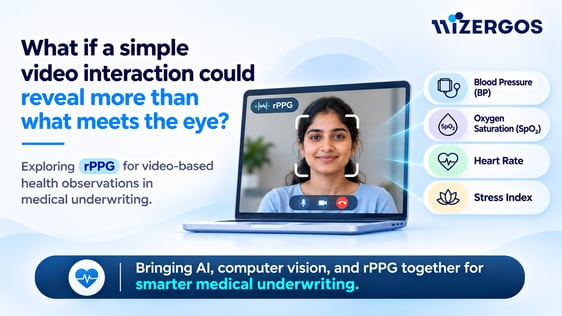
At Wizergos, we're exploring how rPPG technology can enhance digital medical underwriting by deriving physiological insights from an applicant's facial video.
What Is Remote Photoplethysmography (rPPG)?
Remote Photoplethysmography, commonly known as rPPG, is a contactless technology that uses a camera to detect subtle changes in skin colour associated with variations in blood volume beneath the skin.
These changes are often too subtle for the human eye to notice. However, computer vision algorithms can analyse variations across video frames and extract physiological signals.
Unlike traditional photoplethysmography, which generally requires physical sensors such as those found in pulse oximeters and wearable devices, rPPG uses video input to estimate physiological parameters.
This creates an opportunity to introduce contactless health observations into digital insurance workflows.
How Does rPPG Work in Medical Underwriting?
The process begins when an applicant participates in a video-based medical interview.
During the video interaction, the system captures facial video frames and processes them using computer vision and signal analysis techniques.
The technology analyses subtle variations in facial skin colour to derive physiological signals, which can be used to estimate selected health parameters.
The resulting observations can be presented as additional information within the medical underwriting workflow.
Key Health Parameters We Aim to Assess
Our video-based health assessment approach at Wizergos focuses on four key indicators:
1. Blood Pressure (BP)
Blood pressure is an important indicator of cardiovascular health.
rPPG-based approaches aim to estimate systolic and diastolic blood pressure by analysing physiological signals extracted from facial video.
These estimates can provide additional health observations for the underwriting process, subject to appropriate validation.
2. Oxygen Saturation (SpO₂)
SpO₂ represents the percentage of haemoglobin carrying oxygen in the blood.
Through video-based physiological signal analysis, rPPG technology can be used to estimate oxygen saturation levels without requiring a conventional fingertip sensor.
This introduces another potential source of health information during a digital medical assessment.
3. Heart Rate
Heart rate indicates how many times the heart beats per minute.
rPPG detects periodic changes in facial blood volume associated with the cardiac cycle. By analysing these patterns, the system can estimate an applicant's heart rate.
This provides a contactless approach to obtaining one of the commonly observed physiological indicators.
4. Stress Index
Stress-related physiological changes can influence parameters such as heart rate and heart rate variability.
By analysing relevant physiological signal patterns, the system aims to derive a stress-related index that can provide additional context about an applicant's physiological state.
It is important to distinguish this index from a clinical diagnosis of psychological stress.
Why Does This Matter for Insurance Companies?
Integrating video-based health observations into medical underwriting offers several potential advantages:
1. Contactless Health Observations
Applicants can participate in video-based assessments without necessarily requiring additional physical sensors for the parameters being estimated.
2. Digitally Integrated Underwriting
Health observations can become part of an existing digital interview and underwriting workflow.
3. Additional Health Insights
Insurers can explore additional physiological information alongside applicant disclosures, medical history, and diagnostic reports.
4. More Convenient Applicant Experiences
Contactless assessment can reduce dependence on certain physical measurement steps, where validated and appropriate.
5. Technology-Enabled Risk Assessment
AI and computer vision can help insurers explore new ways of collecting and analysing health-related information.
The Future of AI-Powered Medical Underwriting
The future of medical underwriting will involve more than digitising existing questionnaires and documentation.
It will increasingly explore how AI, computer vision, conversational interfaces, and physiological signal analysis can work together to create more comprehensive digital assessment journeys.
At Wizergos, we're exploring the possibilities of rPPG technology to bring video-based health observations into medical underwriting.
Our vision is to make the underwriting journey more intelligent, accessible, and technology-driven while keeping clinical validation and responsible health assessment at the centre.
Because the next evolution of medical underwriting may begin with something as simple as a video interaction.