The conversation around Artificial Intelligence is rapidly evolving. For a long time, the focus was on singular, specialized AI models. Now, with developments like Perplexity's 'Computer'—an AI that delegates tasks to other AIs—we are entering the era of Multi-Agent Systems. This is the shift from a brilliant soloist to a fully coordinated orchestra, capable of tackling problems of far greater complexity. For businesses, mastering the orchestration of these systems is the key to unlocking unprecedented levels of automation and insight.
What is a Multi-Agent System?
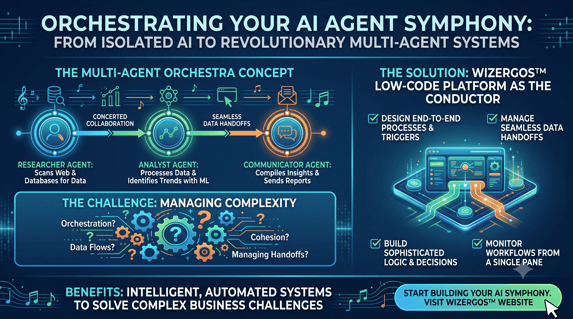
A Multi-Agent System (MAS) is a collection of autonomous, intelligent agents that interact with each other to achieve a common goal that is beyond the capabilities of any single agent. Imagine you need to perform comprehensive market analysis for a new product launch. A multi-agent system might look like this:
- The Scout Agent: Its sole purpose is data gathering. It continuously scans news sites, social media, competitor websites, and internal sales data for relevant information.
- The Analyst Agent: This agent takes the raw data from the Scout, uses Natural Language Processing (NLP) to gauge sentiment, and employs machine learning models to identify key trends, patterns, and statistical anomalies.
- The Strategist Agent: Using the insights from the Analyst, this agent compares the findings against pre-defined business goals and risk parameters to formulate strategic recommendations.
- The Reporter Agent: Finally, this agent synthesizes the analysis and recommendations into a structured, human-readable report and distributes it to the relevant leadership team.
Each agent is an expert in its domain. Their collective power comes from their ability to work together in a seamless workflow.
The Conductor's Challenge: The Problem of Orchestration
The primary challenge in implementing a MAS is not building the individual agents, but making them work together effectively. This is the problem of orchestration. How do you define the sequence of tasks? How does the Scout know when to hand off data to the Analyst? What happens if one agent fails? How do you monitor the health of the entire system?
Traditionally, this would require a team of specialized engineers to write complex, brittle code to manage these interactions—a process that is slow, expensive, and difficult to adapt.
Wizergos: The Low-Code Console for Your AI Orchestra
The Wizergos platform was designed to solve precisely this kind of complex workflow orchestration challenge, making it the ideal environment for building and managing Multi-Agent Systems.
Our platform acts as the conductor's podium, giving you complete visual control over your entire AI ensemble:
1. Visual Workflow Design: Using our intuitive drag-and-drop interface, you can map out the entire multi-agent process. Define the triggers, the flow of data, and the conditional logic that governs how the agents interact, all without writing extensive code.
2. Flexible Integration Fabric: An orchestra is useless if the instruments can't connect. Wizergos allows your agents to seamlessly connect to any data source, API, or enterprise application, providing the real-time information they need to perform their roles.
3. Centralized Management & Monitoring: Instead of managing disparate systems, you can build, test, deploy, and monitor your entire multi-agent application from a single, unified platform, ensuring reliability and simplifying lifecycle management.
It's time for enterprises to think bigger than single AI tools. The future belongs to those who can build and orchestrate intelligent systems. With Wizergos, you don't need to be a coding virtuoso to conduct your own AI symphony.
Ready to bring your agents together? Explore the Wizergos platform today.