In the competitive landscape of the insurance industry, the race to innovate is relentless. Data science teams are leveraging increasingly sophisticated techniques—from advanced GBM and GLM pricing models to cutting-edge methods like normalizing flows and distribution-free conformal prediction—to achieve more accurate pricing and risk assessment. These models hold the promise of revolutionizing underwriting and distribution. Yet, for many carriers, a critical gap remains: the chasm between the data scientist’s notebook and a production-ready application that delivers tangible business value.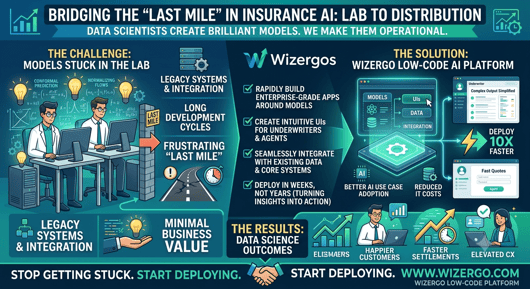
This is the "last mile" problem of insurance AI. A brilliant model is only as good as its implementation, and traditional development cycles are often too slow, costly, and rigid to keep pace with innovation.
The High Cost of the Last Mile
Why do so many powerful models get stuck in development limbo? The reasons are often rooted in technological and organizational friction:
- Legacy System Rigidity: Core insurance systems are often monolithic and were not designed to accommodate the dynamic, API-driven nature of modern machine learning models.
- Long Development Cycles: Building a new application or even just a user interface for a model using traditional coding methods can take many months, requiring extensive coordination between business, IT, and data science teams.
- Integration Hurdles: The new model needs to connect with dozens of data sources, policy administration systems, and customer relationship management (CRM) platforms. Each integration is a complex project in itself.
- Skills Gap: There is often a disconnect between the data scientists who build the models and the front-end/back-end developers needed to build a secure, scalable application around them.
These challenges mean that by the time an application is finally deployed, the underlying model or the market conditions may have already changed, diminishing the potential ROI.
Enter Low-Code: The Deployment Accelerator
A low-code application platform like Wizergos is purpose-built to solve this last-mile problem. It acts as an agile, powerful bridge, enabling insurers to operationalize their AI investments at unprecedented speed.
Here’s how Wizergos makes it possible:
1. Rapid UI/UX Development: Using a drag-and-drop interface and pre-built templates, citizen developers or professional developers can quickly assemble intuitive user interfaces for underwriters, agents, or even customers. This transforms complex model outputs into actionable insights.
2. Seamless Integrations: The platform is designed for connectivity. With minimal coding, it can integrate with virtually any modern application or data source via APIs, allowing your models to access the live data they need to function effectively.
3. Built-in Enterprise-Grade Features: Wizergos comes with enterprise-level security, data privacy protocols, user authentication, and application lifecycle management (ALM) tools. This ensures that the applications you build are not just fast to deploy but also robust, secure, and compliant—a non-negotiable in the BFSI sector.
4. AI/ML Workbench: The platform provides the ability to not only connect to existing models but also to build, test, and use new AI/ML models directly within the ecosystem, streamlining the entire MLOps pipeline.
Imagine your data science team finalizing a new severity distribution model. With Wizergos, a business analyst and a developer could collaborate to build and deploy a fully functional underwriting dashboard that uses this model in a matter of weeks. This agility allows for rapid iteration, testing, and value realization.
Conclusion: From Insight to Impact
The future of insurance distribution belongs to those who can not only create intelligent models but also deploy them swiftly and effectively. The era of waiting years for IT to deliver new tools is over. Low-code platforms like Wizergos are democratizing application development, empowering insurance companies to finally close the gap between data-driven insights and real-world impact. By accelerating the journey from model to market, you can unlock the full potential of your AI investments and build a more dynamic, responsive, and competitive distribution network.
Ready to accelerate your AI adoption? Request a demo of the Wizergos Platform today.