
Medical underwriting has traditionally relied on questionnaires to collect an applicant's medical history. These questionnaires provide structure, but medical histories are rarely as straightforward as a list of questions and answers.
An applicant may disclose a medical condition, mention a medication or describe a lifestyle habit that requires further exploration.
The important question is: Does the underwriting process know what to ask next?
This is where conversational AI can help transform medical underwriting.
The limitations of fixed questionnaires
A fixed questionnaire follows a predefined sequence. Every applicant is presented with a set of questions, and their responses are recorded.
But a single answer can reveal information that deserves a closer look.
Consider an applicant who says they were diagnosed with a heart condition several years ago.
Recording the condition is only the starting point. Understanding the applicant's medical history may require additional questions about the diagnosis, treatment, current medication, follow-up consultations and ongoing symptoms.
If the interview simply moves to the next predefined question, important context may remain unexplored.
Collecting an answer is not the same as understanding the information behind it.
How conversational AI changes the approach
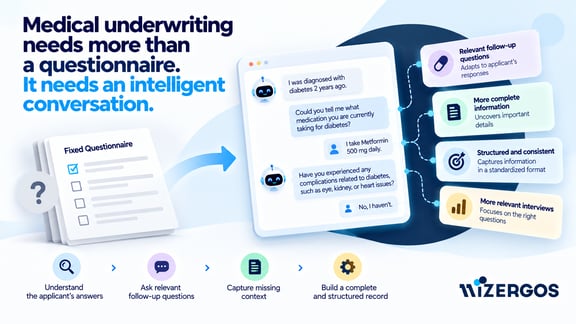
Conversational AI can combine predefined underwriting goals with conditional follow-up logic to make medical interviews more responsive to applicant answers.
Instead of following the same rigid sequence regardless of what an applicant says, the interview can trigger relevant follow-up questions based on the information disclosed.
For example:
Applicant: "I was diagnosed with a heart condition a few years ago."
AI: "When were you diagnosed?"
Applicant: "Around four years ago."
AI: "Did you receive any treatment for the condition?"
The next question depends on the context of the conversation and the underwriting requirements configured for that interview.
This approach can help gather relevant information systematically without requiring every applicant to answer every possible question.
Personalization with structure
An intelligent underwriting interview needs to balance two important objectives.
Consistency: Applicants should be asked the questions required by the insurer's underwriting goals.
Adaptability: Relevant follow-up questions should respond to the information each applicant provides.
Conversational AI can help bring these objectives together.
The process can move from:
Fixed questionnaire → Fixed sequence of answers
to:
Applicant response → Relevant follow-up → Additional context → Structured underwriting data
This makes the interview more responsive while retaining the structure needed for underwriting review.
Better conversations, more useful information
When designed appropriately, conversational AI can support several parts of the underwriting process:
- Relevant follow-ups: Explore important disclosures using predefined rules and conditional logic.
- Consistent questioning: Apply configured underwriting goals across interviews.
- Structured data capture: Organize applicant responses into fields that underwriters can review.
- Improved reviewability: Preserve responses and follow-up information for subsequent assessment.
The effectiveness of this approach depends on the quality of the questioning logic, the accuracy of the captured responses and appropriate validation. AI should not independently infer medical facts that applicants have not disclosed.
The goal isn't to ask more questions
Adding more questions does not automatically improve underwriting.
Too many unnecessary questions can make interviews longer without collecting meaningful additional information.
The opportunity is to identify which questions matter, when they should be asked and what information they are intended to capture.
A well-designed conversational interview aims to gather relevant information without adding unnecessary complexity to the applicant's experience.
The future is conversational
Medical underwriting is moving toward an approach in which technology can do more than present questions and record answers.
Conversational AI offers the possibility of combining structured underwriting requirements with responsive, context-driven interactions.
The objective is not to replace underwriting expertise. It is to improve the information-gathering process so that underwriters have more complete and structured information to assess.
The future of medical underwriting isn't about asking every applicant more questions. It's about asking the right questions, at the right time, to capture the right information.
Because sometimes, the most valuable part of an underwriting interview is not the first answer.
It is the question that comes next.