For a claims adjuster, adjudicating a Motor Third-Party (TP) claim is a high-stakes balancing act. On one hand, the goal is to provide a fair and timely settlement to a genuine claimant. On the other, they are the first line of defense against the pervasive issues of inflated claims and organized fraud, which silently erode an insurer's bottom line. For decades, this process has relied on experience and intuition. But in an era of big data, intuition is no longer enough.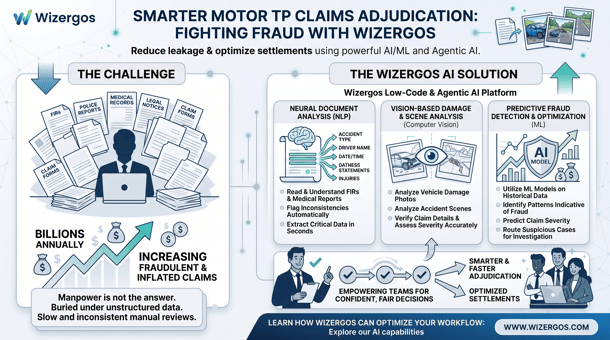
The core challenge lies in the nature of the data itself. TP claims are built on a foundation of unstructured text and images—police reports, witness testimonies, medical summaries, and accident photos. Manually sifting through these documents for red flags is an exhaustive task. This is where Artificial Intelligence, integrated via a flexible platform like Wizergos, becomes a game-changer.
Unlocking Insights with Wizergos' AI Capabilities
The Wizergos Low-Code & Agentic AI platform isn't about replacing the expert adjuster; it's about augmenting their abilities with powerful tools to see what the human eye might miss.
Natural Language Processing (NLP): Extracting a Signal from the Noise An FIR or a medical report is a dense block of text. An NLP model, built and deployed on the Wizergos platform, can ingest these documents and instantly:
Extract Key Entities: Automatically identify and tag crucial information like names of parties involved, vehicle numbers, date and time of the incident, and reported injuries.
Analyze Sentiment and Semantics: Detect inconsistencies between a claimant’s statement and the official police report.
Flag Keywords: Automatically scan for keywords that are historically associated with fraudulent activity.
This transforms a multi-page document into a structured data set, allowing adjusters to grasp the facts of the case in seconds.
Computer Vision: An Objective Eye on the Evidence Photographic evidence is critical, but it can also be misleading. Computer Vision models can be used to analyze images of vehicle damage to:
Assess Damage Severity: Objectively classify damage as minor, moderate, or severe, comparing it against the claimed repair costs.
Check for Prior Damage: In some cases, AI can identify pre-existing damage that is unrelated to the current claim.
Predictive Analytics: Identifying Fraud Before It Hits This is where AI delivers the most significant ROI.
By training Machine Learning (ML) models on years of historical claims data, the Wizergos platform can:
Generate a Fraud Score: Assign a risk score to every new claim based on a complex combination of variables (e.g., type of injury, location, parties involved).
Predict Claim Severity: Forecast the likely settlement amount, helping insurers set more accurate reserves from day one.
Identify Anomaly Rings: Detect hidden connections between seemingly unrelated claims, lawyers, and medical providers, uncovering potential organized fraud rings.
The New Role of the Claims Adjuster
With AI handling the heavy lifting of data processing and pattern recognition, the claims adjuster is elevated from a data gatherer to a strategic decision-maker. Their time is freed up to focus on the most complex, high-risk cases, conduct more thorough investigations, and negotiate more effectively. The result is a claims process that is not only more efficient but also more accurate and fair.
The future of claims adjudication is intelligent. It's a powerful synergy between human expertise and machine intelligence, and with the Wizergos platform, it’s easier than ever for enterprises to build and deploy.
Discover how to embed AI into your claims process. Explore Wizergos today.