The Unrelenting Pace of Change
One day, a government announces a new framework requiring insurers to cover controlled pre-existing conditions. The next, a major group insurance program is pulled from hospitals, exposing unexpected eligibility risks for thousands. These are not hypotheticals; they are real-world events that are fundamentally reshaping the insurance landscape. For insurers, they represent a stark reality: the ground is constantly shifting beneath their feet.
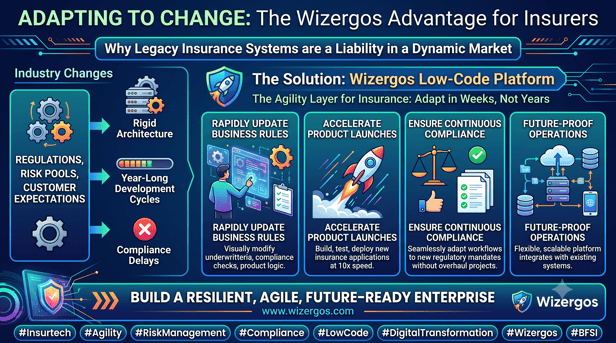
In this environment, the greatest risk isn't a market downturn or a new competitor; it's operational rigidity. Many insurers are running on monolithic legacy systems built decades ago. Their business rules are hard-coded, their architecture is inflexible, and making even a small change can trigger a complex and costly development cycle that lasts for months, if not years. This lack of agility is no longer just an inconvenience—it's an existential threat.
The Monolith Problem: Why Traditional Systems Fail
Legacy core systems were built for a world of stability and predictability. They are ill-suited for today's dynamic market for several reasons:
1. Slow Time-to-Market: Launching a new product or updating an existing one requires extensive coding, testing, and deployment processes.
2. High Cost of Change: Modifying hard-coded logic is expensive and requires specialized, often scarce, programming talent.
3. Compliance Nightmares: Adapting to new regulations becomes a massive, resource-draining project, diverting focus from innovation.
4. Innovation Gridlock: The inability to change quickly stifles experimentation and prevents the business from responding to new opportunities.
Wizergos: Your Platform for Enterprise Agility
True digital transformation is not about a single project; it’s about embedding the capacity for continuous change into the DNA of your organization. The Wizergos Low-Code and Agentic AI platform is designed to be this engine of agility.
Think of our platform as an agility layer that can work with, or gradually replace, your legacy systems. Here’s how we empower insurers to thrive amidst change:
1. Visual, Model-Driven Development: Our low-code console allows business analysts and IT teams to collaborate visually on designing and modifying business processes. Underwriting rules, claims processing workflows, and compliance checks are not buried in obscure code; they are represented as clear, configurable models. A change in regulation can be implemented by modifying a visual workflow, not by rewriting thousands of lines of code.
2. Enterprise-Grade Lifecycle Management: Agility without governance is chaos. Wizergos has built-in support for enterprise-grade lifecycle processes like regression testing and CI/CD pipelines. This means you can make changes quickly and safely, ensuring that new deployments are robust, secure, and reliable.
3. API-First for Seamless Integration: Our platform is built to connect. Whether you need to integrate a new third-party data source for risk assessment or connect a new agent portal, our API-driven architecture makes it simple and fast.
A Practical Example: Responding to a New Mandate
Consider the challenge of adapting to a new rule covering pre-existing conditions. An insurer using Wizergos could:
In Days: A business analyst and developer team up to visually modify the underwriting workflow in the Wizergos console to include new decision logic.
In One Week: They integrate a new data source via API to verify the 'controlled' status of a condition. * In Two Weeks: The new workflow is rigorously tested in the built-in sandbox environment and deployed into production.
What would have taken a year with a legacy system is now a matter of weeks.
In today's insurance market, the winners will be those who can adapt the fastest. Wizergos provides the technological foundation to not just survive change, but to capitalize on it.
Is your organization built for change? Discover how to build a more agile enterprise with Wizergos.